(post written in May 2019 as I finally get around to finishing these posts)
The morning of our last day was spent at the famous Pere Lachaise cemetary which was close to where we were staying.
Showing posts with label France. Show all posts
Showing posts with label France. Show all posts
Friday, March 3, 2017

Tuesday, February 28, 2017
petit palais, sacre coeur
(post written July 2018 as I sort through photos and discover I hadn't quite finished writing up the Paris trip...)
Looks like it was raining in the morning.

We went to the Petit Palais in the morning and looked at art in a cool building.


Lunch was at Angelina... again...


And then we discovered that next door to Angelina, there is a bookstore... one that carries English books. How we missed it after passing by so many times, I don't know...


The weather cleared up, so we headed towards le Sacré Coeur.
We walked up the front stairs (and stopped for a bit for a snack and drinks at a café with a brilliant view of the building)...

We enjoyed the view from the top...


The building itself, both outside and in (though I don't think we went up to the top, I think it was too late in the day? I don't remember).


We went around the corner to take a look at the other church, St Pierre de Montmartre.


Then we walked down the side stairs...


Dinner was with friends at an Ethiopian restaurant. Giant (I think the plate was a foot and a half across) flat soft crepe-ish thing, with various foods. Tear off a piece, scoop up whichever glop you wanted, eat with your fingers. Quite tasty.

Looks like it was raining in the morning.

We went to the Petit Palais in the morning and looked at art in a cool building.
 |
| The front door of the Petit Palais |


 |
| Emile Gallé, ~1878. Vase decorated with Chrysanthemums and Praying Mantis. Enamelled glass. |
 |
| Eugène Feuillâtre, ~1912. Vase "La Mer." Translucent enamel over copper. |
 |
| Greek vases |
 |
| The Grand Palais across the street |
Lunch was at Angelina... again...


And then we discovered that next door to Angelina, there is a bookstore... one that carries English books. How we missed it after passing by so many times, I don't know...


The weather cleared up, so we headed towards le Sacré Coeur.
We walked up the front stairs (and stopped for a bit for a snack and drinks at a café with a brilliant view of the building)...

We enjoyed the view from the top...


The building itself, both outside and in (though I don't think we went up to the top, I think it was too late in the day? I don't remember).

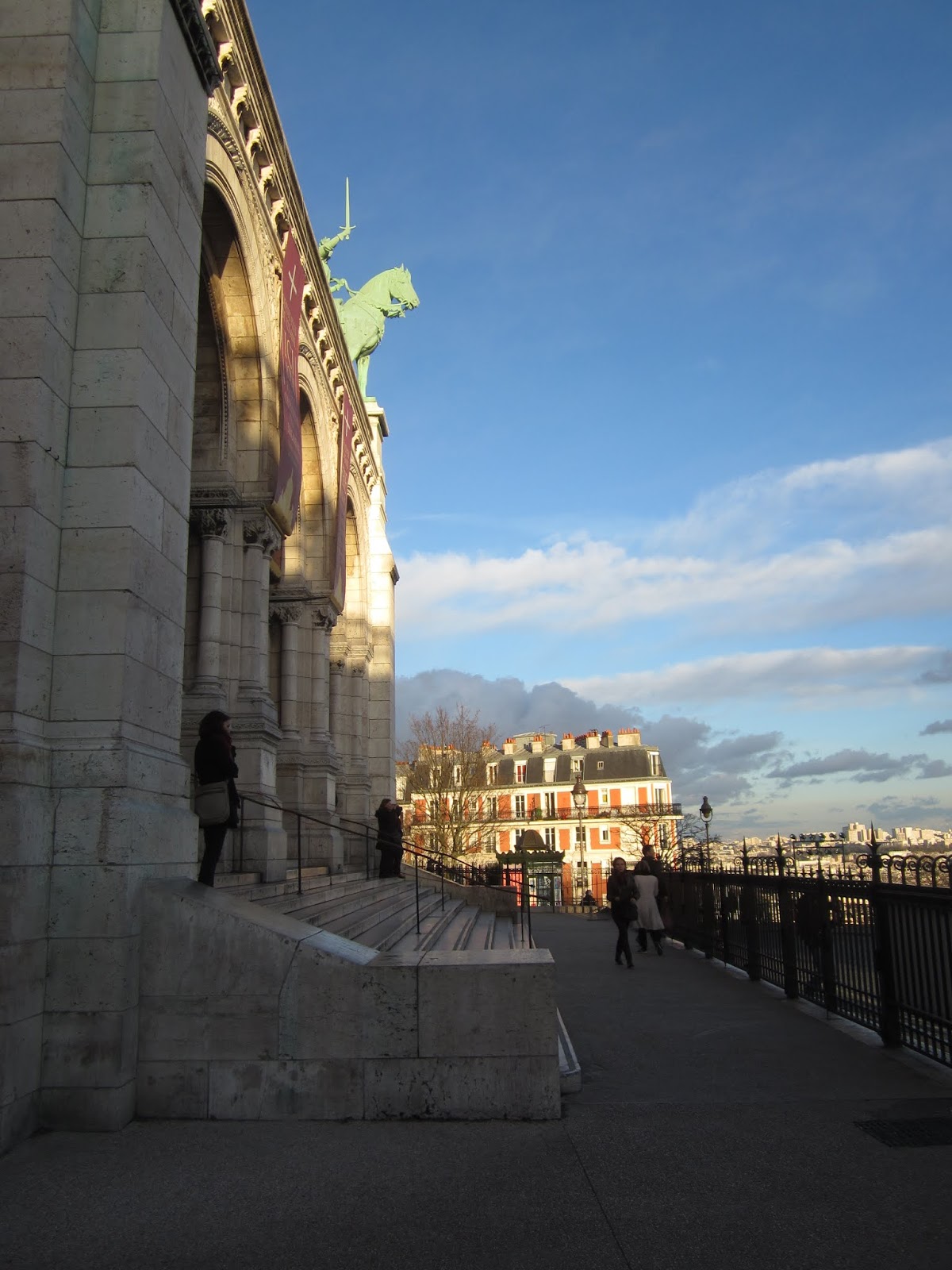


We went around the corner to take a look at the other church, St Pierre de Montmartre.


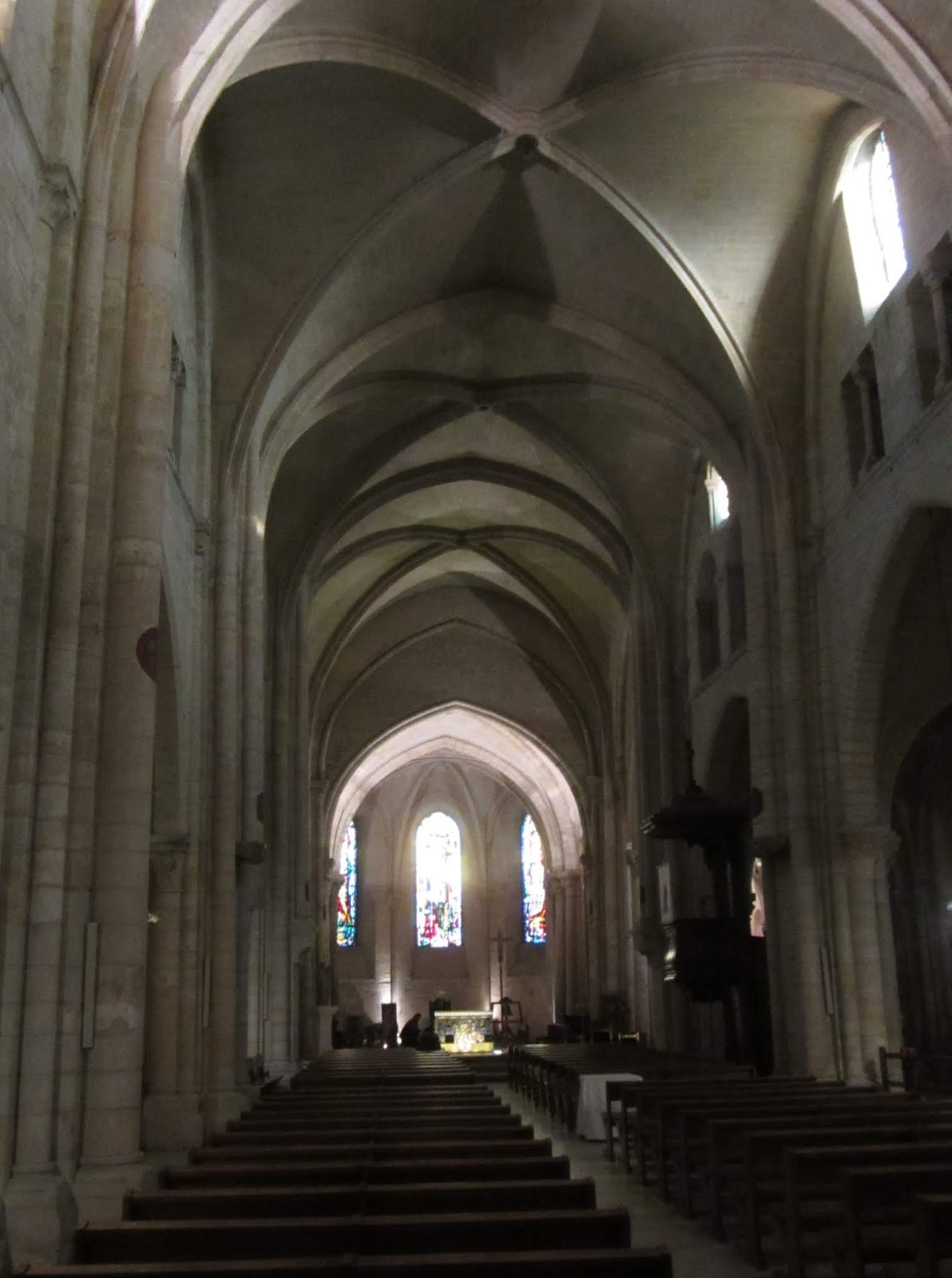
Then we walked down the side stairs...


Dinner was with friends at an Ethiopian restaurant. Giant (I think the plate was a foot and a half across) flat soft crepe-ish thing, with various foods. Tear off a piece, scoop up whichever glop you wanted, eat with your fingers. Quite tasty.

Monday, February 27, 2017
fancy
Last time we were in Paris, the closest we got to Le Palais Garnier was across the street. This time, I insisted we go in, since I'd heard it was interesting. We expected to spend maybe half an hour or an hour... we were there the whole morning.


Sunday, February 26, 2017
shiny gold
We went to Versailles without much of a plan. We knew, because I'd looked it up beforehand, that there was some kind of equestrian performance, and that tours existed.


Saturday, February 25, 2017

Friday, February 24, 2017
arrival in paris
(It is now the beginning of April, and I am finally getting to writing up our trip to Paris - I've backdated the posts.)
This time, we decided to fly to Paris, instead of taking the train. This was not a bad idea. We took the RER and metro into the city, and when we emerged, the first thing both of us did was be tourists.
This time, we decided to fly to Paris, instead of taking the train. This was not a bad idea. We took the RER and metro into the city, and when we emerged, the first thing both of us did was be tourists.
Wednesday, August 6, 2014
walk like an egyptian
Tuesday, August 5, 2014
many steps
The plan for the day involved climbing the towers of Notre Dame, looking at the inside, the Crypts, Sainte-Chapelle and then possibly other things on or off the Ile de la Cité if we had time.
We got to Notre Dame pretty much when we intended - a bit before the towers opened.
We decided to stand in line and reassess the plan after.
We got to Notre Dame pretty much when we intended - a bit before the towers opened.
 |
| This is half the line. |
Monday, August 4, 2014
day off

Lazy mornings are nice.
Sunday, August 3, 2014
many instruments
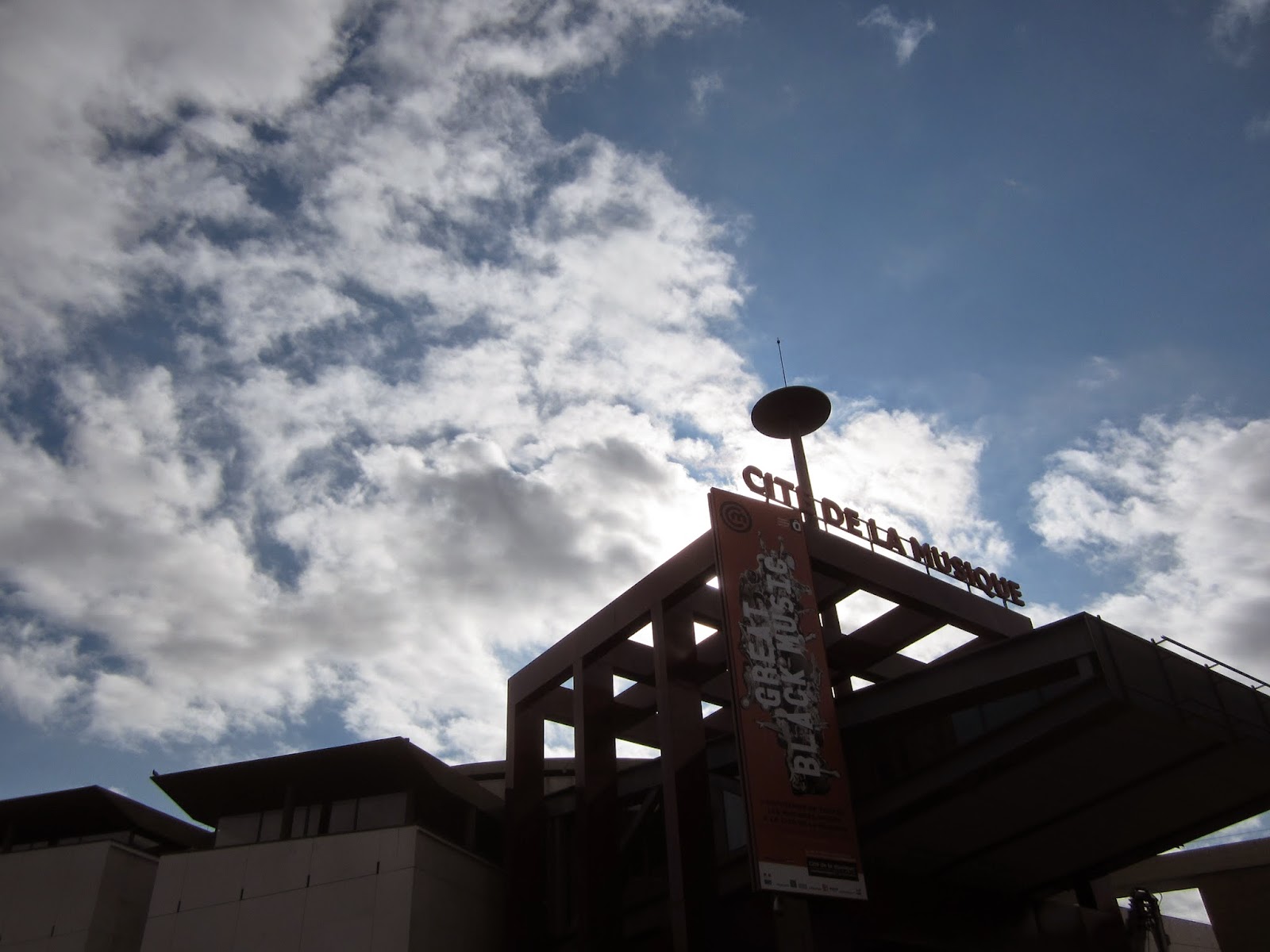
When I was last in Paris, as part of my university's orchestra tour celebrating Berlioz during the summer of 2003, we spent a day at the museum of music at the Cité de la Musique. I remember feeling like I hadn't had enough time there, and that it was really interesting, and wanted to go back. So G (a nonmusician) indulged me, and we did.
Saturday, August 2, 2014
trees, cows and naked ladies
When we arrived at the Musée D'Orsay, about 20 minutes before opening, nobody was there yet. We decided to go around the corner to a café for something warm to drink and a croissant to fortify us for the morning of art. When we came back round the front of the museum at 9:30am for the opening, there was already a moderate line - but luckily we were still in time to not have to wait long.
 |
| Musée D'Orsay |
Friday, August 1, 2014
arrival
 |
| We have arrived. |
Monday, April 14, 2014

Sunday, July 14, 2013
sparkle lights
We have just returned from a stunning fireworks display.
About a three minute walk from our apartment is the main city library (or médiathèque, if you prefer). It is a strange, upside-down U shaped building straddling the top of one of the city's main boulevards. Behind the médiathèque lies a square where there's some kind of city-related-something, some little stores (convenience store, pharmacy, bakery kind of thing; mostly we care about the bakery) and apartments. It is here that the city has chosen for les feux d'artifice du 14 juillet (it's Bastille Day).
About a three minute walk from our apartment is the main city library (or médiathèque, if you prefer). It is a strange, upside-down U shaped building straddling the top of one of the city's main boulevards. Behind the médiathèque lies a square where there's some kind of city-related-something, some little stores (convenience store, pharmacy, bakery kind of thing; mostly we care about the bakery) and apartments. It is here that the city has chosen for les feux d'artifice du 14 juillet (it's Bastille Day).
Wednesday, April 3, 2013
smell the flowers
It's been months since I posted, but here I am again, hopefully to start posting semi-regularly again. I've had lots of little ideas of things to post about, but just never got around to it... I haven't even emptied my camera since Christmas, that's how lazy I've been.
However, the weather is beautiful today. And we live just a short walk away from this:


It's what I believe to be the highest point of Toulouse. There is an obelisk (visible in the background of the third photo) - a monument to some battle that Napoleon fought, I think - and a bunch of old observatories, most of which were built in the late 1800s and house or housed telescopes of varying sizes, according to the signs next to them. There's also open spaces, flowers (or potential flowers), paths, a jungle gym, people of all ages walking around with and without dogs, small people making lots of noise and running, a little house with a lot of cats, birds singing, bees buzzing... It's really nice to visit, and I should really do so more often.
However, the weather is beautiful today. And we live just a short walk away from this:


It's what I believe to be the highest point of Toulouse. There is an obelisk (visible in the background of the third photo) - a monument to some battle that Napoleon fought, I think - and a bunch of old observatories, most of which were built in the late 1800s and house or housed telescopes of varying sizes, according to the signs next to them. There's also open spaces, flowers (or potential flowers), paths, a jungle gym, people of all ages walking around with and without dogs, small people making lots of noise and running, a little house with a lot of cats, birds singing, bees buzzing... It's really nice to visit, and I should really do so more often.
Wednesday, August 29, 2012
Monday, July 16, 2012
More organ pictures
Since I had to be kind of choosy about the pictures I shared in Robin McKinley's guest blog post (part three is here), I'm putting up some of the less good (or less relevant) photos here. A few may be duplicates of photos already posted, but in higher resolution.

Thursday, July 12, 2012
Birds
In mid-June, G, his parents and I went to the Parc Ornithologique de Pont du Gau - a large wildlife preserve in the Camargue delta, where hundreds on hundreds of water birds spend time. We got lucky - a few minutes after we arrived, a walking tour started, allowing us to learn far more about the various species we were seeing than we would otherwise be able to. The Parc does avian rehabilitation, has several birds on display (mostly raptors, most of which I presume are injured and cannot be released). I also got to use G's father's nice camera to play with. Which I think is about all the introduction to this than you need. (sorry, this post is a little picture-heavy) :)
Wednesday, July 11, 2012
Organ guts
Here is the second part of G and I's visit to the organ :)
http://robinmckinleysblog.com/2012/07/11/the-organ-of-eglise-notre-dame-la-dalbade-part-ii-2/
http://robinmckinleysblog.com/2012/07/11/the-organ-of-eglise-notre-dame-la-dalbade-part-ii-2/
Thursday, July 5, 2012
Visiting an organ (part 1)
Back in May, G and I had the wonderful opportunity of seeing the insides of a 19th century church organ. Since Robin McKinley's piano teacher also plays organ, she has posted occasionally about organs, and I thought perhaps some of her regular blog readers might enjoy an account of our experience.
The post is a bit long, so Ms. McKinley has split the post into pieces. The first installment was posted today.
http://robinmckinleysblog.com/2012/07/05/the-organ-of-eglise-notre-dame-la-dalbade-part-i/
------
edit 2018
Robin McKinley rebooted her blog, and the archives are no longer accessible to the public. I managed to find the original text lurking in the depths of my computer, but will have to do some hunting in order to find the photographs, but the captions are there...
------
The post is a bit long, so Ms. McKinley has split the post into pieces. The first installment was posted today.
http://robinmckinleysblog.com/2012/07/05/the-organ-of-eglise-notre-dame-la-dalbade-part-i/
------
edit 2018
Robin McKinley rebooted her blog, and the archives are no longer accessible to the public. I managed to find the original text lurking in the depths of my computer, but will have to do some hunting in order to find the photographs, but the captions are there...
------
This
post is all Robin’s fault. After all, if she hadn’t mentioned
folding origami the other day, I would not have desired to fold some
origami myself, then gotten lost looking a little paper shop, seen an
intriguing old-looking building in the process of finding the correct
street, gone around to the front of the intriguing old-looking
building, gone inside, and discovered that there was going to be
something that involved organs the next day.
And
if Robin hadn’t, in the past, posted occasionally about Oisin and
his obsession about organs, and a little bit about how organs are
really cool, I might not have gone to said event involving organs.
But being sort of a musician, and thinking that organs might be kind
of interesting, my boyfriend and I went.
I
was expecting a recital or something. What we got was a brief
recital… followed quickly by the opportunity to go up into the
organ loft, see the keyboards, the stops, the pedals, hear the organ
from the galleries as well as from the organ loft, go into the back
and see (some of) the insides of the organ, see and hear the various
pipes, hear how the different stops affect the sound of the
instrument, watch a little of how the mechanics of this incredible
instrument work, and then get to doodle around a little on the
instrument myself.
---
The
Eglise Notre-Dame La Dalbade is in the Carmes neighborhood of
Toulouse. Surrounded by other old buildings*, it stands on one of
the many twisty streets that meander through this medieval city.
When I made a wrong turn looking for the paper store and saw the high
walls with the old gothic buttresses, I had to investigate. Built of
the red brick that gives the city its nickname of La Ville Rose, it
has an entrance with carved columns and a beautiful mural depicting
the coronation of the Virgin Mary surrounded by angelic musicians.
<IMG
4857 : Front of church.>
It
seems that the original church, built in the 6th
century, was white – hence its name**. After being destroyed in a
fire in the 15th
century and rebuilt in the 16th,
it acquired its current red brick and the tallest bell tower in
Toulouse. It houses an organ, built by Eugène Puget in 1888***. In
1926, the bell tower collapsed, taking a small secondary organ and a
large portion of the church with it****. Luckily, the main organ was
minimally damaged, and the church was rebuilt in the 50s (some of the
organ’s restoration at that time was performed by Eugène’s
grandson Maurice).
When
I ventured inside Friday afternoon, I admired the vaulted ceilings,
the stained-glass windows, the paintings and statues in the alcoves…
all the usual things I look at when I enter these old churches. Some
churches, including this one, have fabulous organs – the detailed
carving of the dark wood is always amazing to behold. This organ was
designed to frame a beautiful rose window. I was a little surprised
to hear someone playing on it, though – all the other organs I’ve
seen have been silent when I visited. They were clearly practicing –
the same run was played several times, the music stopped and started,
and after a while, I became aware that there were two people in the
organ loft – the player and someone who seemed to be instructing
the player. I enjoyed the music, such as it was, and after taking
several photographs of the church’s interior, I prepared to leave.
<IMG
4885: Rose window.>
As
I turned to the exit, I took a quick look at the bulletin board. A
poster caught my eye – Presentation
de l’orgue historique
Puget 1888, it said.
The date was, serendipitously, that of the next day. I took a
picture of it (so I’d remember) and showed it to my boyfriend that
evening after he got home. He thought it might be interesting –
why not go?
<IMG
4892: Flyer. Background is a drawing (I believe by Puget) of the
original organ’s conception and/or construction (I am not
completely clear on that part).>
And
so, as the morning turned to noon on Saturday, we entered the church.
Again, there was somebody practicing at the keyboards as we wandered
up the center aisle. There were very few people there – maybe a
half dozen at first, though there were perhaps as many as fifteen or
twenty by the time we left. Shortly after we sat down in the pews, a
man came down, asking if we were here for the organ? We were. Were
we organists? No… Ah well, come on up anyway.
<IMG
4898: The organ. Unfortunately the best picture I got was crooked.>
Initially,
after climbing the twisty wooden steps to the level of the organ loft
†, we were led into the galleries along the right (as you face the
altar) side of the church. The organist, a young woman from Japan,
played an arrangement of a CPE Bach cantata (I think). The acoustics
of this spot were different from where we had been on the floor of
the church and the difference in how the echoes reflected back to us
was audible. I also was able to see the stained glass windows around
the church better from this elevated viewpoint, and noticed some of
the little carvings at the tops of the columns and other details that
had not been visible from ground level.
<IMG
4913: View from galleries.>
After
the Bach, our little group was then treated to an informal couple of
hours of playing, demonstration, and explanations by the professional
organist, Mr. de Miguel (the instructor I’d seen up there the day
before) and a young man who we believe to be an apprentice organ
builder. Unfortunately, my French was unequal to the task of
comprehending everything that was said, but even the 1/3 – 1/2 that
I understood was extremely interesting. Anything I get wrong is
entirely due to the fact that I know almost nothing about pipe organs
to start with, the men who explained things talked really fast, and
my understanding of French is as yet rather imperfect. Many thanks
to boyfriend, who, as a native of this country actually understood
most of it, and was later able to explain things to me that I didn’t
quite follow at the time.
<IMG
4920: The pipes from the organ loft.>
Eugène
Puget, the second of four generations of organ-builders in Toulouse,
built this organ, which was inaugurated in 1888. Its most recent
restoration, about two years ago, was due to damage during the
droughts and heat of 2004, and cost more than €500,000. It is
apparently unusually playable, having a relatively light action ††.
There are three manuals, a pedalboard and fifty stops, each labeled
with a different instrument and pipe length. It also has the ability
to control dynamics and has a number of “effects” pedals which
affect the tonal quality of the instrument. These features provide
this organ an extremely versatile range of tones and colors, and
allows for everything from a simple, pure sound to a fully symphonic
sound.
<IMG
4910: The keyboards and stops.>
<IMG
4925: The pedals. The flat wood pedals in the center above the
keyboard pedals control volume. The metal pedals on either side
control other effects.>
An
electric air generator now replaces the original man-powered bellows,
forcing air up toward the organ’s pipes continuously. When all the
stops are in, airflow to the pipes is blocked, and no sound emerges
if you press a key. When a stop is pulled out, a particular
“instrument” is activated, and air flows to the pipe
corresponding to the key pressed by opening a hole by means of some
really very clever mechanics. The more stops are opened, the more
“instruments” sound when a key is pressed. As I understand it,
each manual corresponds to some of the stops, and you can hook things
up so one manual controls more than one manual’s worth of stops†††.
<IMG
4942 - 4943: Stops in and out.>
The
current organ has been modified from its original design. At one
time, there was a small organ that was in the same location as the
keyboards. This is a holdover from a time when organs actually were
portable instruments! ‡
The pipes associated with this organ have since been moved inside
the main instrument, and are surrounded by a series of vertical
levered wooden slats which can be opened and closed by means of two
foot-pedals to control the volume of the sound produced.
We
got to see the insides of the organ – hundreds of pipes in all
different sizes crammed into a fairly small space – and we could
only see about 1/3 of the pipes (there’s not a lot of space in
there for visitors, and access is via a trap door and a rickety
wooden ladder). There are both metal and wood pipes. The pipes can
be tuned (this is not a job I would want!) by means of adjusting
curls of metal on the metal pipes, or adjusting a sort of stopper
thing on the wood pipes‡‡‡. Not all the pipes sound by means
of air moving past appropriately shaped holes – some have a
vibrating piece inside instead.
<IMG
4927: Just a few of the smaller pipes. The pipes in the foreground
are about waist-high.>
<IMG
4936: Note curls on metal pipes. These can be rolled to varying
degrees to tune these pipes.>
<IMG
4938: Note handle above wooden pipes and slot in side with a slidey
thing inside. The stopper can be moved up and down to tune these
pipes.>
<IMG
4940: Another view of the handle/stopper tuning mechanism of wood
pipes.>
<IMG
4933: The vibraty bit for some of the pipes.>
The
organists of Toulouse rotate churches they play in on a regular
basis. Mr. de Miguel was amazing to watch as he navigated the
several manuals, pedal board and stops (often reaching arm-over-arm
to pop a stop in or out as he kept playing with the other hand, as
well as manipulating the tone color with his feet), and kept track of
music with THREE staves (as a primarily string player, who only has
to keep one track of one staff at a time, I found it dizzying to just
follow along). There were Post-It notes on the music to help him
remember what stops he wants set on this instrument, and hand-written
markings all over indicating when to change the stops. We were
treated to demonstrations of some of the versatility of this
instrument. It can do the full-out classic organ sound one
associates with Bach’s famous Toccata and Fugue… or a light,
fluty sound suitable for Fauré or Debussy… a symphonic richness
for orchestral rearrangements... music reminiscent of an oboe
concerto… the list goes on and on.
Anybody
who wanted to was also allowed the opportunity to play a little on
the organ. I was surprised at how easy the action was – it felt
more “solid” than a piano, and had the peculiar quality that it
didn’t matter how hard I pressed the key, it didn’t affect the
volume§. Each manual has the same octave range as the other two
(the pedals seem to be what play the deep bass) but based on how the
stops are arranged, one can get a full range of notes, from
almost-inaudibly low to tooth-achingly high, as well as imitating the
sounds of different instruments. I was also surprised at how quickly
the sound responded. The quiet wooden shuffle-clack of the Barker
mechanism behind the bench was a little distracting at first, but
apparently do their job well, as the sound was almost immediate when
the key was depressed. The sound was a little muted from the vantage
of the bench, compared to elsewhere in the organ loft, but easily
audible and it was not at all difficult to hear what I was doing (and
realize when I’d made a mistake!)
<IMG
4961: What’s easily visible of the Barker mechanism. The “wall”
behind the organist is actually a sliding door which hides this. The
“room” where we were with all the pipes is above and behind
that.>
I’m
not much of a keyboardist – it’s been months since I’ve had
access to a piano, and years since I’ve played much – but I made
some attempts at the first third or so of Bach’s cello suite in
C§§, a few lines from a Mozart piano sonata and the first section
of Für Elise§§§. The organist adjusted the stops as I went –
it was fascinating to hear how the different pieces sounded and
changed as the stops went in and out. It was very much fun. I
didn’t do much with the pedals – played a few notes just to do
it, but what keyboard ability I own lives in my fingers, not in my
feet.
All
in all, the afternoon was wonderful. Apparently Saturday was
National Organ Day, and Toulouse, being the second most
organ-populated city in France, had to do something, and this is what
was planned. Mr. de Miguel was very passionate about how the organ
has declined in popularity, and how many instruments are unplayable
(including another, almost identical Puget organ in a theater in
Paris), and is hoping that publicizing and demonstrating this amazing
instrument, more people will become interested in learning more about
the organ.
There’s
apparently going to be an organ concert at the Basilique Saint-Sernin
next weekend…
*
The building across the way, for example, has a plaque on it dating
it to the 16th century.
**
That would be the Dalbade part (dealbata
= whitewashed in Latin)
***
According to this website (
http://www.toulouse-les-orgues.org/les-orgues/instruments/toulouse-16/toulouse/eglise-notre-dame-la-dalbade.html
), Puget actually rebuilt and expanded on a previously present organ
built in 1850 by Prosper Moitessier.
****
The French Wikipedia site has a couple photos of the tower before and
after its collapse.
http://fr.wikipedia.org/wiki/%C3%89glise_Notre-Dame_de_la_Dalbade
† The
floor of the loft trembled slightly as people moved around. I found
this somewhat alarming at first, though I did get used to it. Being
a Californian by upbringing, all I have to say is, thank goodness
they don't seem to get earthquakes around here. Most of the city
would be rubble.
†† Mr.
de Miguel, the organist, mentioned another organ in town (I think
this one:
http://www.toulouse-les-orgues.org/les-orgues/instruments/toulouse-16/toulouse/eglise-du-gesu.html?lang=fr
) that is very difficult to play due to the heaviness of the keys,
which is related to the mechanism that transmits the key movement to
the air-opening-bit of the organ.
††† It’s
rather odd to watch someone playing on one manual (or the pedals) and
seeing other keys on the other manuals moving simultaneously).
‡ From
poser
(to place), it is called the “positif."
Again according to the website above, the positif
of this organ is mostly what's left of the Moitessier organ.
‡‡ Boyfriend
thinks they said over 3000 pipes. We do know that they ranged in
length from less than a foot to 32 feet in length. The stops are
labelled, plus we could see them.
‡‡‡ Mr.
de Miguel mentioned that they had tuned most of the pipes Friday
night in preparation for Saturday - a task that took two people over
six hours, and lasted til past 1am.
§
This is sort of like many unsophisticated electric keyboards – but
those are “bouncy” and difficult to play in my experience. This
keyboard was much more substantial.
§§
I started with that on the theory that it’s really hard to mess up
a descending C major scale, followed by some broken chords before it
got to the more interesting bits, and I thought I could probably
mostly sound it out as I went along.
§§§
It happens that at one time, I had all of the afore-mentioned piano
music memorized... about ten years ago. It was kind of embarassing
how little I could remember. I so need a piano.
Subscribe to:
Posts (Atom)